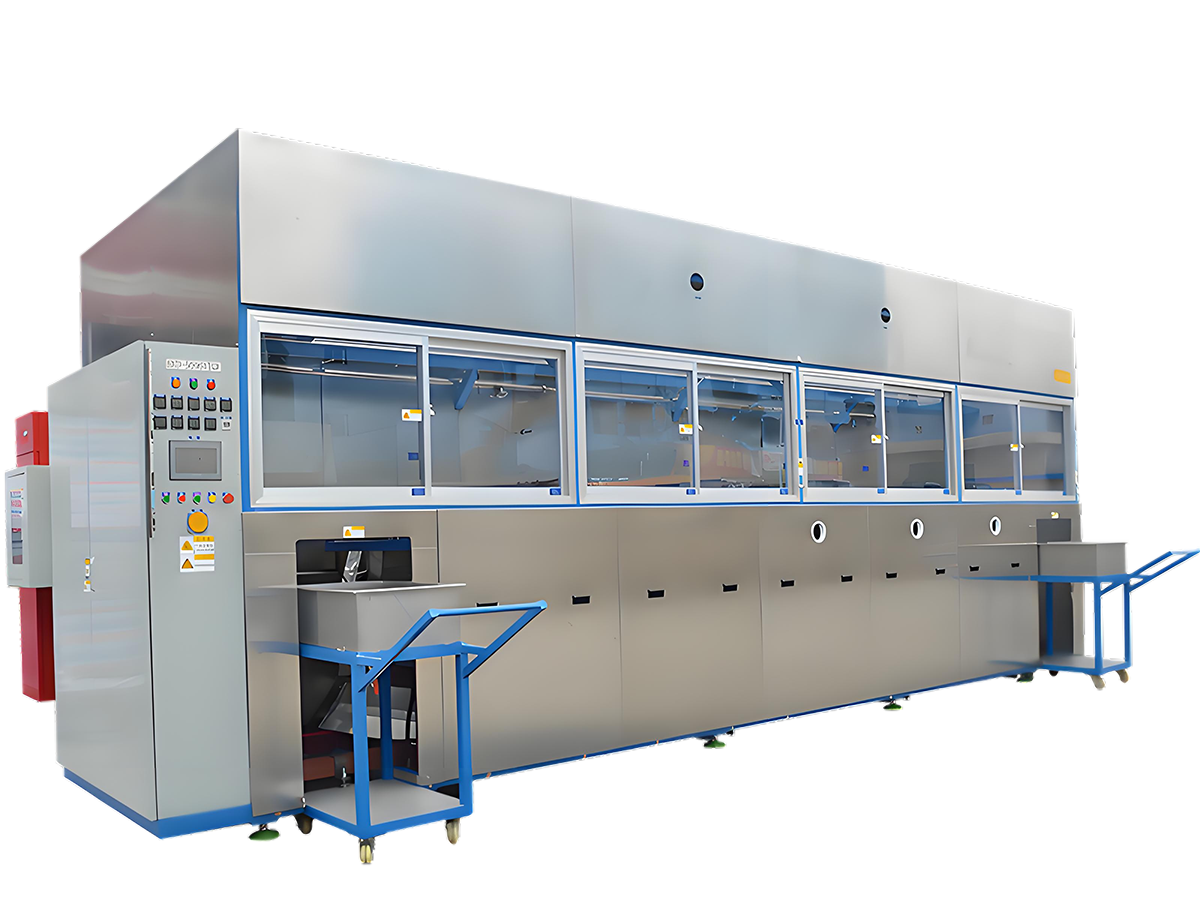
### I. Technical Principles and Core Mechanisms
The core technology of ultrasonic cleaning machines is derived from the cavitation effect. When ultrasonic waves (usually with a frequency of 20 - 100 kHz) act on a liquid, the liquid molecules generate alternating dense and sparse fluctuations under the vibration of the sound waves, forming countless micron - sized bubbles. These bubbles rapidly expand and then instantly collapse under changes in sound pressure. When collapsing, the shock wave generated can reach thousands of atmospheres, and the local temperature can rise to several hundred degrees Celsius in an instant. This physical effect can efficiently peel off oil stains, particles, and even microorganisms from the surface of objects, and is particularly good at cleaning complex structures that are difficult to reach by traditional methods (such as blind holes and thread gaps).
Its working principle can be decomposed into three levels:
- Cavitation impact: The high pressure at the moment of bubble rupture directly breaks the dirt layer.
- Micro - jet effect: The liquid forms high - speed micro - flows under the action of sound waves, scouring the surface.
- Chemical synergy: The cleaning agent accelerates the penetration and dissolution of pollutants under the action of ultrasound.
Modern devices usually integrate multi - frequency ultrasonic generators (such as a combination of 28/40/68 kHz). By intelligently switching frequencies, they can adapt to different materials and types of pollutants. For example, high - frequency (68 kHz) is more suitable for precision electronic components, while low - frequency (28 kHz) is used for treating heavy oil stains.
### II. Technical Advantages and Industry Innovation
Compared with traditional cleaning methods (such as chemical immersion and high - pressure water guns), ultrasonic cleaning machines show significant advantages:
- The cleaning efficiency is increased by 3 - 5 times. For example, after a certain auto parts enterprise introduced it, the single - piece cleaning time was shortened from 15 minutes to 3 minutes.
- Environmental protection and emission reduction: The use of chemical solvents is reduced by more than 70%, meeting the requirements of the EU REACH regulations.
- Non - destructive cleaning: It can achieve zero - damage cleaning for fragile items such as cultural relic restoration and jewelry.
In 2024, the market size of ultrasonic cleaning machines in China has reached 5.8 billion yuan, with an annual growth rate of 12.3%. Industrial - grade equipment accounts for 65%, and medical and laboratory equipment has the fastest growth rate (an annual increase of 18%). Leading enterprises such as GoodSky have launched intelligent models equipped with IoT functions. Users can remotely monitor cleaning parameters through a mobile APP, and the data is uploaded to the cloud in real - time for process optimization.
### III. Diverse Application Scenarios
- **Precision Manufacturing**
In fields with extremely high cleanliness requirements such as semiconductor wafers and optical lenses, ultrasonic cleaning can remove particles of 0.1μm level. For example, SMIC uses multi - tank fully automatic equipment to achieve a residual amount of surface pollutants on silicon wafers of less than 5ppm.
- **Medical Disinfection**
The complex structure of surgical instruments is prone to the growth of biofilms, and traditional high - temperature sterilization cannot completely remove them. Ultrasonic waves combined with enzymatic cleaning agents can increase the sterilization qualification rate from 85% to 99.9%. Data from Peking Union Medical College Hospital shows that the postoperative infection rate has decreased by 40%.
- **New Energy Industry**
In the coating process of power battery electrodes, ultrasonic cleaning replaces chemical etching to remove the oxide layer on copper foils, reducing the battery internal resistance by 15%. Tesla's Shanghai factory has fully adopted this process.
- **Cultural Heritage Protection**
The Palace Museum uses customized low - frequency ultrasonic equipment to clean the corrosion of bronze wares. Without damaging the cultural relics themselves, the cleaning efficiency is 20 times higher than that of manual cleaning.
### IV. Technological Innovation and Development Trends
- **High - frequency and Composite Frequency Technologies**
Japanese companies have developed 120 kHz ultra - high - frequency equipment that can achieve nanoscale cleaning and is used for ultra - clean treatment before chip packaging. The composite frequency technology (such as the alternation of 28/68 kHz) reduces the residual carbon particles by 90% in the cleaning of automobile engine parts.
- **Research and Development of Green Cleaning Agents**
Biodegradable cleaning agents (such as plant - based surfactants) and ultrasonic waves work together to reduce the COD value of wastewater from 2000 mg/L to less than 50 mg/L. The pilot project of CSOT has achieved 100% recycling of cleaning fluid.
- **AI - driven Intelligent Systems**
The AI - enabled cleaning machine launched by Haier can automatically match the best frequency (adjustable by ±2 kHz) and temperature by visually identifying the type of stains, reducing energy consumption by 30%. Its self - learning system has accumulated more than 100,000 sets of data, and the response time for optimizing cleaning parameters is less than 0.5 seconds.
- **Modularization and Miniaturization**
Desktop - type miniature devices (such as DISSEN DN - 08) weigh only 3.5 kg but have a standard frequency of 40 kHz, becoming standard equipment in laboratories and jewelry stores. The modular design allows users to freely combine cleaning, rinsing, and drying units, reducing the production line transformation cost by 60%.
Ultrasonic cleaning technology is evolving from an auxiliary tool to a core part of intelligent manufacturing. With the advancement of the "double - carbon" goal, its energy - saving characteristics (50% more power - saving than traditional cleaning) will accelerate its industrial penetration. It is expected that by 2030, the global market size will exceed 200 billion yuan. China, with its complete industrial chain and innovative ecosystem, is expected to occupy more than 40% of the market share, writing a new chapter of "Made in China 2025".

地址:
Room 801, 8th Floor, Building 1, No. 90, Aigehao Road, Weitang Town, Xiangcheng District, Suzhou City联系电话:
15250467891邮箱:
jiwenchang@spring-sz.comCopyright © 2025 润斯普瑞超声科技(苏州)有限公司版权所有 苏ICP备2021041029号-1
欢迎致电:
15250467891
打开微信扫一扫
联系我们